Archaeology.Today
Field Report

LED Imaging Reveals Hidden Soil Differences at Danish Excavation

A multispectral imaging system developed by Aarhus University and Moesgaard Museum uses 16 LED wavelengths to expose archaeological soil differences that ordinary photographs may miss. Tested at the Iron Age site of Sorte Muld, the system also made small bone fragments easier to detect under ultraviolet light.

September 2, 2026
1 Source
Sorte Muld
LED Imaging Reveals Hidden Soil Differences at Danish Excavation
The Story

A relatively inexpensive imaging system developed by researchers in Denmark is giving archaeologists additional ways to distinguish buried deposits before they remove them. The prototype, known as LEDMSI, illuminates excavation surfaces with LEDs operating at 16 wavelengths, spanning near-ultraviolet, visible and near-infrared light.

The system was developed by Aarhus University and Moesgaard Museum and tested at Sorte Muld, an archaeologically rich Iron Age site on Bornholm. The site contains more than a meter of dark deposits formed through centuries of human activity. Many of its layers are thin, irregular and visually similar, making their boundaries difficult to identify in ordinary photographs.

LEDMSI repeatedly photographed the same soil section under the different wavelengths. Researchers then applied statistical analysis to the combined images, enhancing differences in the way materials absorbed or reflected light. According to the report from Phys.org Archaeology, the resulting images revealed changes that were difficult to see with the naked eye, including features that may represent separate deposits.

One feature could be an earlier ground surface and possibly a pause in activity at the site. The researchers emphasized that this interpretation still requires confirmation. The system’s immediate value, they said, is its ability to direct attention toward differences that might otherwise go unnoticed.

The imaging also produced a potential advantage for locating bone. Small fragments fluoresced under ultraviolet illumination and became easier to distinguish from the surrounding soil. The study found that useful information could be collected without the optical filters normally used in fluorescence photography, simplifying the equipment. The researchers did not demonstrate that LEDMSI can identify the best samples for ancient DNA analysis, although fluorescence in archaeological bone has previously been associated with collagen preservation.

The prototype is estimated by the researchers to cost roughly 20 times less than hyperspectral imaging systems used for similar archaeological applications. A second-generation version, equipped with a better camera and two LED units, has since been tested at Fredbjerg in northern Jutland, a cemetery dating to the late Viking Age and early Christian period. There, preservation is poor and some graves are visible mainly as faint soil shadows. Multispectral images helped the team choose locations for additional sampling.

The newer system captures its image series in about 30 seconds, compared with up to five minutes for the initial prototype. The researchers are working toward near-immediate processing in the field and eventually hope to use machine-learning software to help distinguish different materials, while keeping archaeological judgment central to interpretation.
Reference Desk

Sources & Further Reading

Continue Exploring

Related Archaeology

More stories
Denmark’s Largest Known Viking Age Silver Hoard Found in a Backyard
01
Artifacts
Score 65

Denmark’s Largest Known Viking Age Silver Hoard Found in a Backyard

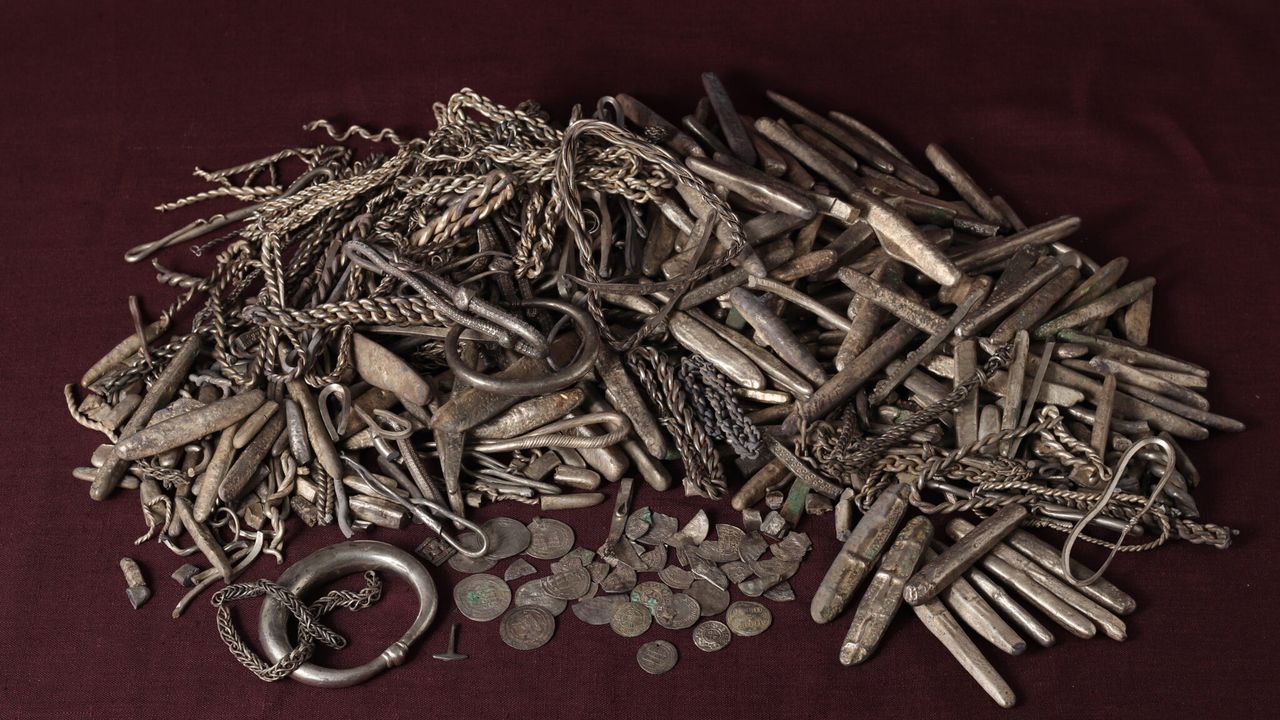
A homeowner in Rebild discovered about 18.5 kilograms of silver while preparing a terrace. The roughly 1,100-year-old hoard contains around 700 objects, including coins, bars, jewelry and a small Thor’s hammer, and is nearly three times larger than Denmark’s previous largest known Viking Age silver hoard.

Read story
Old Kingdom Official’s Tomb and Burial Shafts Found at Saqqara
02
Bioarchaeology
Score 40

Old Kingdom Official’s Tomb and Burial Shafts Found at Saqqara

An intact tomb belonging to the high-ranking official Sekhentio-Ptah has been uncovered in Saqqara’s Bubasteion Necropolis, along with interconnected burial shafts. The discovery includes inscribed funerary elements, alabaster ritual objects, human remains and more than 100 faience ushabti figurines.

Read story
Inner-Ear Bone Study Traces Population Change in Prehistoric Northeast Africa
03
Human Origins
Score 20

Inner-Ear Bone Study Traces Population Change in Prehistoric Northeast Africa

An analysis of bony labyrinths from 148 prehistoric and recent individuals identifies continuity among Middle Nile Valley foragers but a marked morphological break after the emergence of Neolithic food-producing communities. The results also point to substantial population diversity and possible isolation across northeastern Africa.

Read story
Study Finds La Mojana Raised Fields Could Have Been Built Cooperatively
04
Discoveries
Score 20

Study Finds La Mojana Raised Fields Could Have Been Built Cooperatively

An analysis of pre-Hispanic canal-and-ridge systems in Colombia’s La Mojana suggests that a 500-hectare network could have been constructed by local communities within one dry season. The findings challenge the assumption that landscapes covering more than 500,000 hectares required centralized political control.

Read story
Roman Shipwreck Carrying Hundreds of Amphorae Found off Sicily
05
Underwater Archaeology
Score 20

Roman Shipwreck Carrying Hundreds of Amphorae Found off Sicily

Italy’s Carabinieri cultural heritage protection unit has located a Roman shipwreck about three miles off Mazara del Vallo, Sicily. The approximately 2,100-year-old vessel contains around 500 amphorae, along with parts of anchors, and will undergo further scientific documentation.

Read story
Virtual Hunting Study Tests How Easily Fallow Deer Could Be Seen
06
Discoveries
Score 20

Virtual Hunting Study Tests How Easily Fallow Deer Could Be Seen

Two online visual-search experiments examined how fallow deer coat patterns, distance and body orientation affected human detection in a simulated Pleistocene woodland. The results may help interpret proposed projectile lesions on deer bones in the archaeological record.

Read story