A study of the bony labyrinth—the system of cavities inside the temporal bone that contains the organs involved in hearing and balance—has identified contrasting patterns of continuity, population change and diversity among Homo sapiens in prehistoric northeastern Africa.
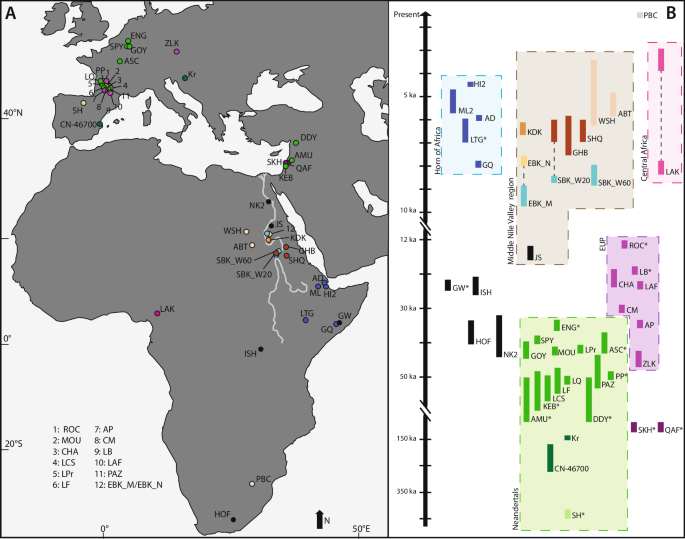
The research examined 148 individuals, represented by 194 bony labyrinths, dating from approximately 44,000 to 3,000 years ago. The sample included remains from the Middle Nile Valley, the Horn of Africa and Central Africa, alongside comparative specimens from other parts of Africa, Europe and the Levant, as well as recent southern African individuals. The researchers used three shape-analysis methods to investigate biological affinities in a region where ancient DNA is scarce.
Across the different analyses, Late Pleistocene African specimens showed broad similarities with Early Holocene foragers from the Middle Nile Valley. These patterns, together with similarities to earlier African Homo sapiens fossils, are consistent with deep regional ancestry and morphological continuity among some foraging populations.
The pattern changed among local Neolithic food producers. Their bony labyrinths displayed distinct morphologies, supporting the interpretation of a major demographic shift beginning about 8,000 years ago. This finding agrees with earlier dental research that had suggested population discontinuity during the Neolithic transition in much of the Middle Nile Valley, although other studies have proposed continuity in some peripheral desert or isolated Nile settings.
The researchers also identified a recurring group of outliers from Holocene contexts in the Middle Nile Valley and the Horn of Africa. A subgroup of Early Holocene Nile Valley foragers combined unusual bony labyrinth shapes with congenital pathological changes specific to the inner ear. The authors say these features are consistent with possible syndromic conditions, but they outline several possible demographic explanations for the pattern, including prolonged endogamy and geographic isolation caused by environmental constraints.
Comparisons involving the Horn of Africa and Central Africa revealed high morphological diversity during the Middle and Late Holocene. The researchers interpret this as evidence of strong population substructure and changing demographic trajectories, while noting that morphological similarity indicates potential biological affinity rather than proving direct ancestry.
The study argues that bony labyrinth morphology can provide useful population-history evidence where ancient DNA cannot be recovered. Its interpretation combines skeletal shape, archaeological information and regional climate patterns, which alternated between conditions that may have encouraged movement and periods of aridity that could have restricted mobility and fragmented populations.