Pre-Hispanic raised fields in Colombia’s La Mojana region may have been built and maintained through relatively modest, cooperative labour rather than centralized command, according to research published in Nature Archaeology.
The study examined the spatial organization, form and estimated earth volumes of canal-and-ridge systems within a 500-hectare area. The researchers calculated that local inhabitants could have constructed the entire system during a single dry season. They also estimate that restoring it fully once in a generation would have required only a few days of labour each year.
These estimates do not establish exactly how the systems were organized, but they indicate that their large scale alone cannot be treated as proof of top-down planning or coercive authority. The authors argue that construction may instead have been possible through local groups working at different scales.
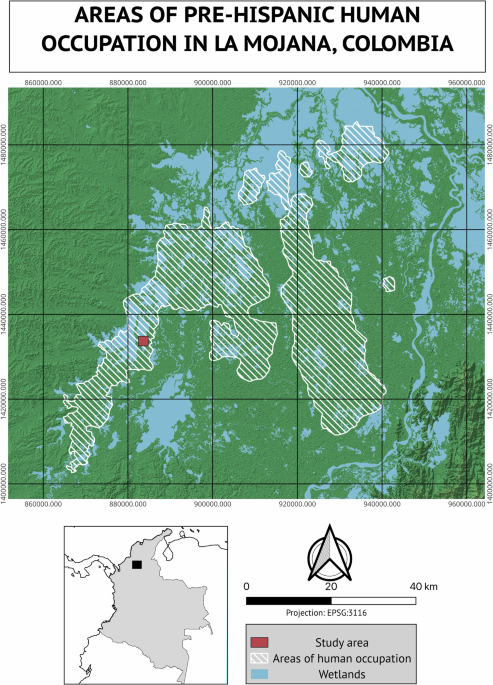
The systems, often called Zenú hydraulic systems, extend across more than 500,000 hectares of the Colombian Caribbean lowlands, near the confluence of the Magdalena, Cauca and San Jorge rivers. Their canals and raised ridges helped redistribute water and fertile soil, allowed cultivation above flood levels, and moved fish from permanent wetlands toward areas of settlement.
Evidence places their use from the last centuries BC through the 10th or 11th centuries AD. Because the systems accumulated over more than 1,000 years, not all of their components were necessarily built or used at the same time. The precise chronology of individual systems remains difficult to establish because absolute dating evidence is scarce.
The research also considers whether these practices could inform present-day water management. Raised fields can retain water during heavy rainfall and release it during drier periods, while improving drainage and soil conditions. This contrasts with modern strategies centered on dikes, which have sometimes been breached by high-volume currents and have contributed, along with other factors, to environmental damage and the drying of some wetlands.
A contemporary initiative led by APROPAPUR has recreated the canal-and-ridge approach across six hectares since 2012. Thirty people have helped build fields during each dry season, benefiting approximately 80 to 100 people from about 30 families. The researchers present this example, together with the archaeological estimates, as evidence that low-cost and locally managed water and land practices may be scalable—although the modern test area remains far smaller than the pre-Hispanic systems.