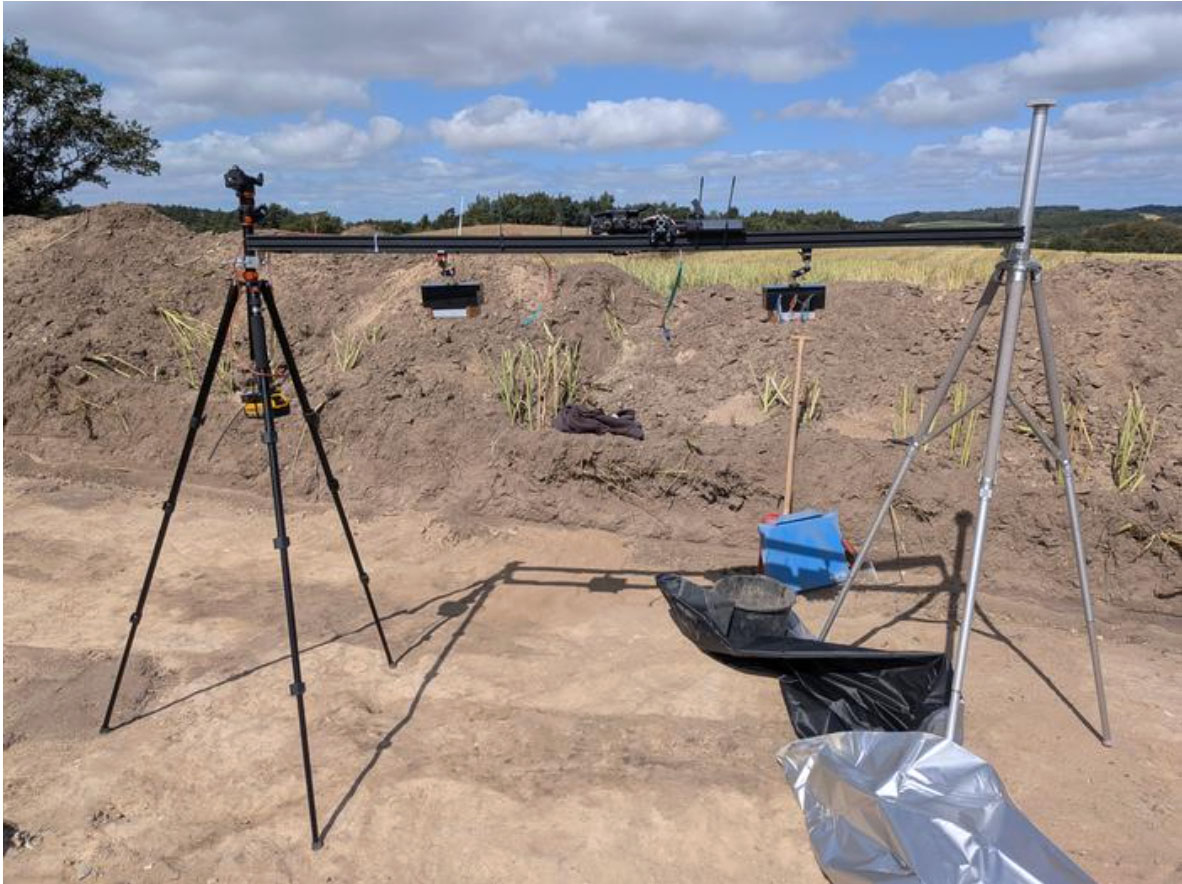
A new LED-based imaging system could help archaeologists assess buried remains and changes in soil before opening an excavation trench. The LED multispectral imaging system, or LEDMSI, uses 16 lights emitting different wavelengths, ranging from visible light to near-ultraviolet and near-infrared light.
The system was developed by a team that includes Søren Munch Kristiansen of Aarhus University and David Stott of the Moesgaard Museum. Its first tests took place at Sorte Muld, an Iron Age site on the Danish island of Bornholm.
Materials absorb and reflect different wavelengths in different ways. By photographing the ground under varied lighting conditions, the researchers can produce images that reveal contrasts not readily apparent in ordinary daylight. The resulting photographs were analyzed on a computer after fieldwork.
At Sorte Muld, the images showed additional layers and changes in the material filling the site. One change in the ground surface may mark a break in activity, although excavation will be needed to determine whether that interpretation is correct. The imaging therefore provides a possible target for further investigation rather than a confirmed archaeological conclusion.
The tests also showed that small bone fragments fluoresced under ultraviolet light. Earlier research has connected fluorescence in archaeological bones with collagen, a finding that can be useful when assessing their potential for DNA and protein analysis. The source material does not indicate that such analyses have yet been conducted on the fragments identified at Sorte Muld.
The researchers are continuing to develop and test LEDMSI. Its potential use before excavation could allow archaeological teams to identify areas requiring closer examination while preserving the distinction between features suggested by imaging and results confirmed through digging.