Aerial laser scanning has revealed hundreds of previously hidden earthworks in southwestern Amazonia, supporting a substantially larger estimate for the region’s precolonial population than earlier surveys allowed. The study, published in Nature, identifies more than 20,000 earthworks across the wider cultural area and proposes a population of 1.25 million to 3 million people around AD 100–300, when researchers believe the society was at or near its peak.
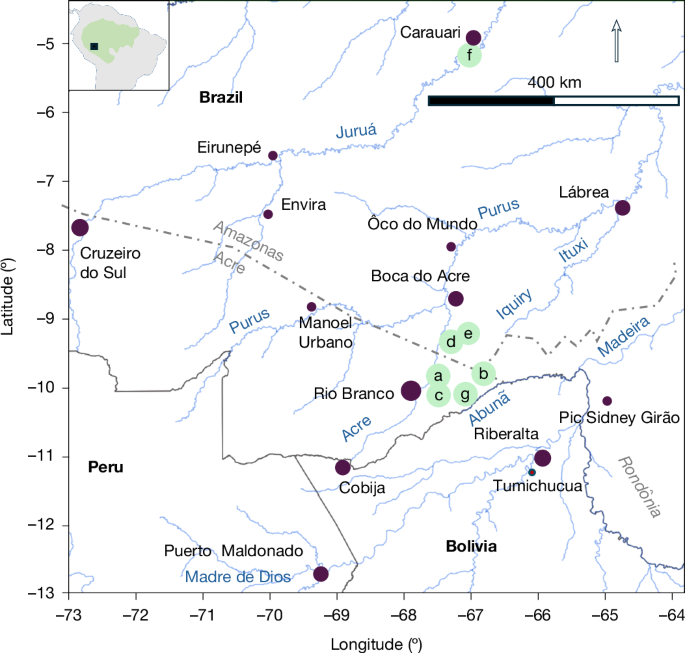
The research team used canopy-penetrating LiDAR, a form of airborne laser scanning that can produce terrain models beneath forest cover. In 2024, the team surveyed 4,430 kilometers of flight lines covering 4,497 square kilometers in the Brazilian states of Acre and Amazonas. The survey documented 432 earthworks, only 36 of which had previously been known.
Combined with earlier satellite, aerial-photograph and archaeological data, the new results allowed the researchers to refine the estimated extent of what they call the Aquiry civilization. The broader inventory includes more than 20,000 earthworks—about as many as previous estimates had assigned to the whole of Amazonia.
Many of the structures are geometric enclosures surrounded by ditches and embankments, often referred to as geoglyph-type earthworks. Their size generally ranges from 0.35 to 14 hectares, while the largest known example is nearly 50 hectares. Ditches are typically 9 to 13 meters wide and can reach as much as 5 meters below the surrounding surface.
The geometric geoglyphs were built between about 600 BC and AD 850, according to Bayesian modelling, although other earthworks in the region belong to later periods. LiDAR also showed that embanked enclosures without ditches are more common than satellite imagery had suggested. The researchers associate quadrilateral and multilateral examples with the Aquiry complex, while many roundish embankments date to after AD 1000–1200.
The study describes the Aquiry earthworks as likely public, ceremonial and political centers rather than places of permanent occupation. That interpretation remains a conclusion drawn from the structures’ arrangement and archaeological context, not a direct identification of their function.
The survey also found limits to the distribution. No earthworks were detected along several flight lines across upland areas between the upper Purus and upper Juruá rivers, although the researchers note that dense forest may have prevented accurate terrain modelling. They suggest the absence could alternatively reflect areas that were not permanently inhabited.
The authors caution that their population estimate is tentative and based on the surveyed cultural area. If comparable concentrations are found elsewhere in Amazonia, they say estimates of precolonial population density—and the effects of past human activity on forests, soils and biodiversity—may need to be reassessed.