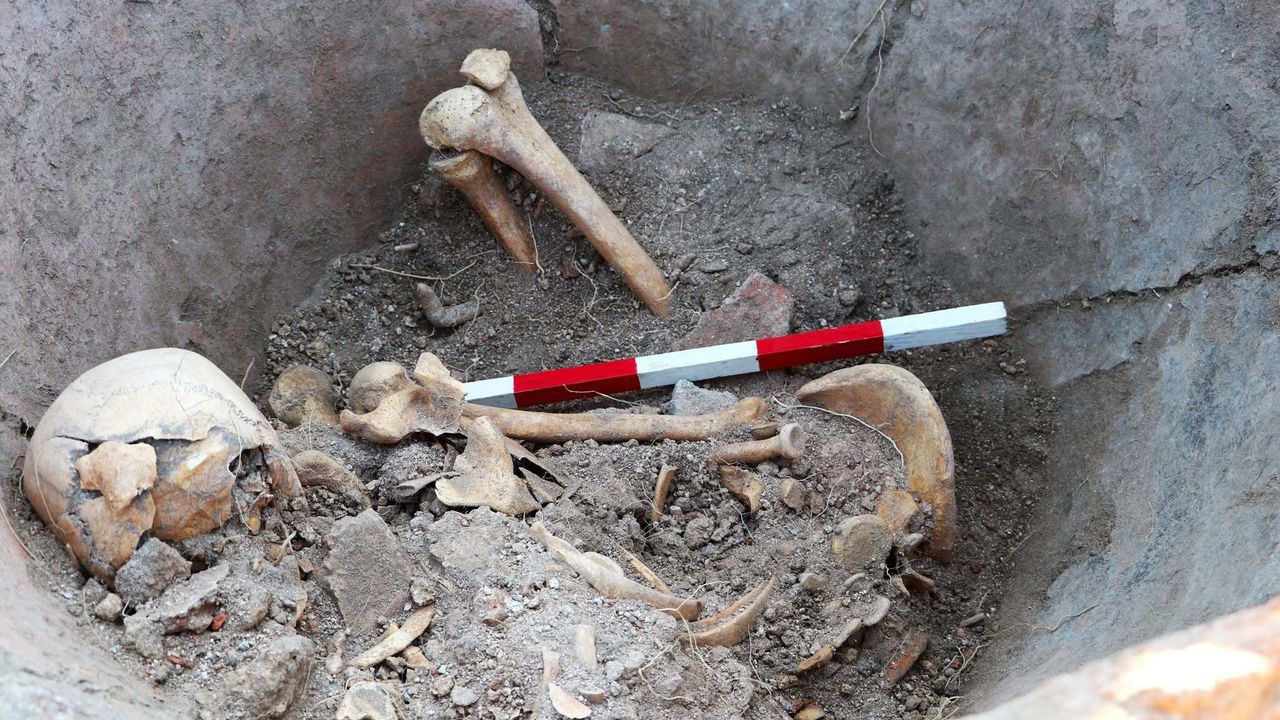
A human skeleton discovered inside a giant Roman storage jar may preserve the remains of a man who took refuge during an attack on the Bulgarian city of Deultum approximately 1,600 years ago. Archaeologists found the vessel in the northern turret of the settlement’s western Roman gate on Aug. 10.
The jar was a dolium, a large ceramic container used in antiquity to store products such as olive oil and wine. Although some dolia could hold more than 260 gallons (1,000 liters), the surviving lower portion of the vessel at Deultum measured about 3 feet (1 meter) across.
The skeleton was accompanied by two iron knives and a belt. Lead excavator Lyudmil Vagalinski of the Bulgarian Academy of Sciences told Live Science that the individual was presumably a young man. One knife was found between his legs, while the other remained in his belt—an arrangement Vagalinski said could indicate that he was prepared to defend himself if attackers discovered him.
The excavation area contained extensive evidence of destruction, including ashes, coals, broken bricks and roof tiles, blackened walls, melted glass and burned animal bones. Archaeologists also recovered numerous bronze coins that may have been lost during the disorder. Based on this context, the team believes residents may have brought livestock into the fortified area when an attack appeared imminent.
Vagalinski said the man may have climbed into the empty dolium after the fire had already started. Ashes beneath the skeleton support that possibility, although the cause of the fire and the specific conflict remain unknown. Deultum faced attacks by East Germanic tribes and Huns during the fourth and fifth centuries, but the discovery cannot currently be linked to a particular battle.
The position of the remains resembles that of a sleeping person, and researchers found no indication that the individual tried to leave the vessel. The team’s preliminary dating places the destruction around A.D. 400.
After the attack, inhabitants apparently leveled the damaged turret and built a higher floor over it without realizing that the body remained inside the jar. The remains have been transferred to Sofia for examination by a physical anthropologist. Archaeologists plan to return next summer to investigate more of the western gate, which dates to approximately A.D. 300, and continue work on the turret.