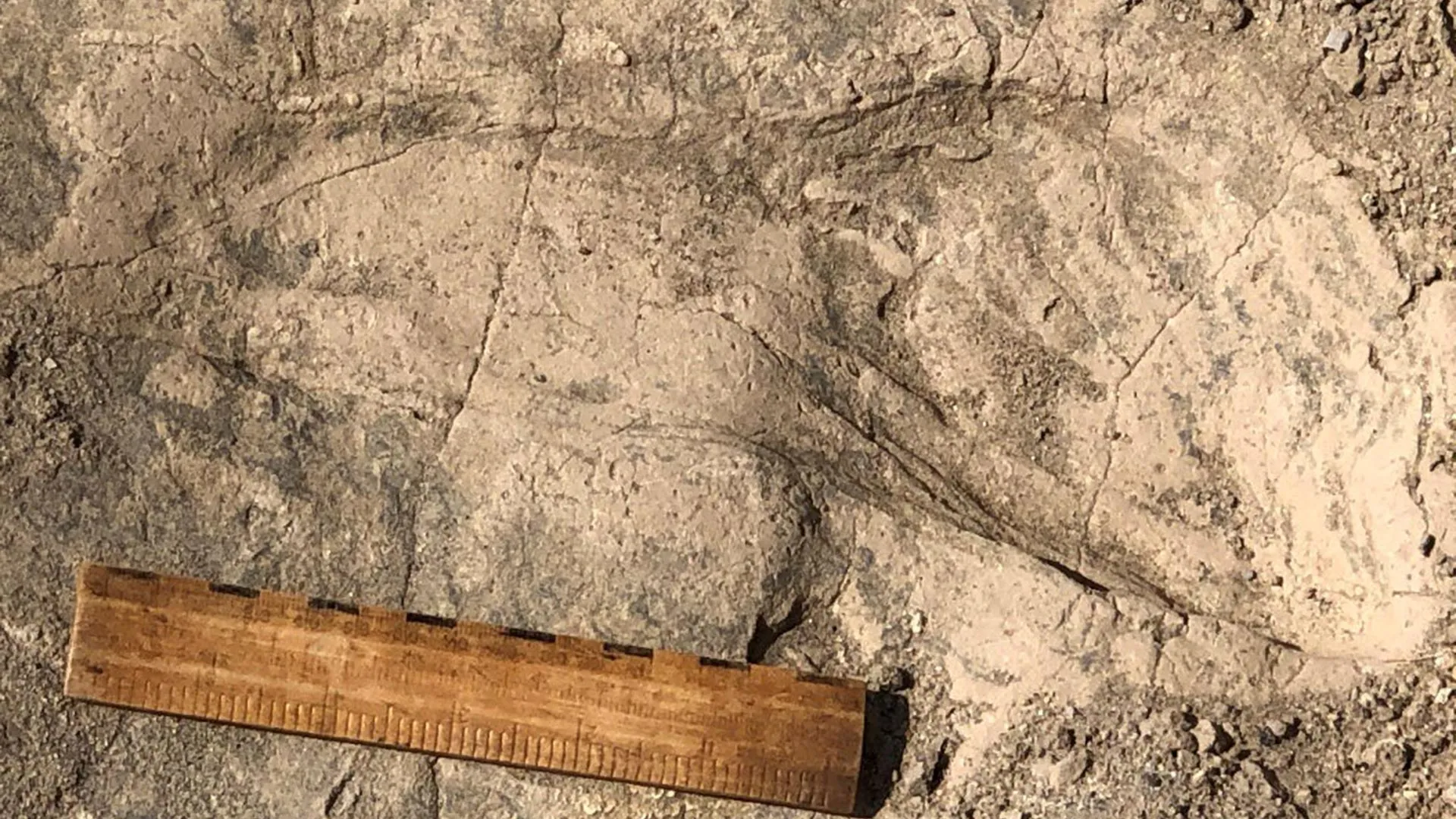
A trail of 1.4-million-year-old footprints from northern Kenya appears to record eight Paranthropus boisei individuals moving together along an ancient lakeshore. The tracks also indicate that some members of this extinct human relative may have been considerably larger than earlier skeletal estimates suggested.
The international research team, involving scientists from the United States and Kenya, identified the footprints using analytical methods developed by the group in 2024. Their classification relied on features of foot anatomy and the way the individuals moved. The researchers said all eight trackmakers were probably adults, and most appear to have been male.
Footprint dimensions point to human-like body sizes, with some individuals estimated to have stood as tall as 1.8 meters and weighed about 75 kilograms, according to lead author Kevin Hatala of Chatham University and the Max Planck Institute for Evolutionary Anthropology. The estimate is notable because much of the known fossil record for Paranthropus boisei consists of skulls, including specimens with large jaws and teeth. Fossils from the rest of the body are much rarer.
The tracks therefore provide evidence about body size that is difficult to obtain from the available skeletal material. The findings also challenge earlier research suggesting that P. boisei was substantially smaller than Homo erectus, which lived during roughly the same broad period.
Because footprints can form and be preserved over a relatively short interval, they can capture behavior in a way that bones accumulated over long periods generally cannot. In this case, the researchers interpret the tracks as evidence that eight individuals were traveling together. The apparent absence of females or children led them to suggest that the group may reflect a more complex social structure, although the footprints cannot establish the group’s exact relationships or behavior.
The discovery comes from a wider concentration of hominin footprints around Lake Turkana. Researchers have documented hundreds of tracks at more than six sites in the region, including lake-margin deposits in two parts of East Turkana separated by about 40 kilometers and dating to approximately the same period. They propose that lakeshores repeatedly attracted hominins because they offered important resources, but the specific reasons for those visits remain under investigation.
The team plans to return to Kenya to continue studying the footprint sites. Their findings, published in Proceedings of the National Academy of Sciences, demonstrate how trackways can contribute evidence about anatomy, locomotion, social behavior and past environments beyond what skeletal fossils alone reveal.