
Archaeology.Today
Field Report

Zendaya’s Earrings Prompt Provenance Questions Over Ancient Iranian Artefacts

Earrings worn by Zendaya at a London photocall have renewed scrutiny of the ownership, provenance and ethical treatment of ancient objects in the luxury market. The gold plaques are attributed by their dealer to Iran’s Ziwiye hoard, but academics and heritage advocates are calling for documentation and examination.

September 2, 2026
1 Source
Ziwiye hoard
Zendaya’s Earrings Prompt Provenance Questions Over Ancient Iranian Artefacts
The Story

Gold earrings worn by actor Zendaya at a London photocall have prompted calls for greater transparency over the ownership and history of ancient artefacts attributed to Iran’s Ziwiye hoard.

Zendaya, who plays Athena in The Odyssey, wore earrings consisting of gold medallion plaques mounted with diamonds in yellow gold. Barron London, the Mayfair gallery and dealer that owns them, says the plaques are “attributed to the Ziwiye hoard,” which was discovered in north-west Iran in the late 1940s. The company bought them from London jeweller Glenn Spiro.

The attribution does not establish that the objects came from the hoard, and the available reporting does not confirm their authenticity or legal history. A petition launched by Romina Frohar, founder of the Forensic Archive of Iran, asks Barron London to publish the plaques’ complete known provenance, disclose checks into their legality, allow the objects to be examined and suspend their sale.

Frohar said that describing the loan as a celebration of ancient Persian artistry was not a substitute for making evidence about the objects’ origin, export, ownership history and acquisition available for scrutiny. She also argued that ethical questions could remain even if the earrings were authentic and lawfully possessed, including whether private custody provides sufficient transparency, conservation and public or scholarly access.

Christos Tsirogiannis, an antiquities expert at the Swiss Federal Office of Culture, expressed surprise that no one involved in accompanying the actor had raised concerns about the jewellery. He also said the plaques might possibly have come from a burial, raising the question of whether they could have been looted earrings once belonging to an ancient woman.

The dispute reflects wider concerns over the market for ancient objects. Tsirogiannis said his work had uncovered evidence casting doubt on the provenance of numerous antiquities offered for sale, while estimating that about 90% of market antiquities are eventually shown to be illicit or lacking documentation. The article also notes that ancient objects including Egyptian, Hellenistic and Iranian items are currently offered by dealers, alongside high-value sales at auction.

Simon Mackenzie, a criminology professor at Victoria University of Wellington, said many countries, including Iran, have state-ownership laws covering ancient objects discovered within their territory. However, he noted that such laws developed over time and were not necessarily retroactive, leaving room for legal disputes about when state ownership began.

The earrings’ ownership and provenance may remain unresolved, but their public appearance has renewed debate about how ancient cultural material is presented, traded and worn in the present day.

Reference Desk

Sources & Further Reading

Continue Exploring

Related Archaeology

More stories
Roman Shipwreck Carrying Hundreds of Amphorae Found off Sicily
01
Underwater Archaeology
Score 20

Roman Shipwreck Carrying Hundreds of Amphorae Found off Sicily

Italy’s Carabinieri cultural heritage protection unit has located a Roman shipwreck about three miles off Mazara del Vallo, Sicily. The approximately 2,100-year-old vessel contains around 500 amphorae, along with parts of anchors, and will undergo further scientific documentation.

Read story
Medieval Coin Hoard of 2,600 Silver Pieces Found in Kolomna
02
Artifacts
Score 20

Medieval Coin Hoard of 2,600 Silver Pieces Found in Kolomna

Archaeologists have uncovered about 2,600 silver coins inside a ceramic jug in Kolomna, western Russia. Most are dengi minted by rulers of the Grand Principality of Moscow, while more than 350 appear to be previously unknown local varieties.

Read story
Painted Walls and Mosaic Floors Found in Smyrna’s Agora
03
Artifacts
Score 20

Painted Walls and Mosaic Floors Found in Smyrna’s Agora

Researchers led by Akin Ersoy of İzmir Katip Celebi University have uncovered three possible public spaces dating to the fifth and sixth centuries A.D. in Smyrna’s agora, along with wall paintings found in the agora and theater.

Read story
Denmark’s Largest Known Viking Age Silver Hoard Found in a Backyard
04
Artifacts
Score 20

Denmark’s Largest Known Viking Age Silver Hoard Found in a Backyard

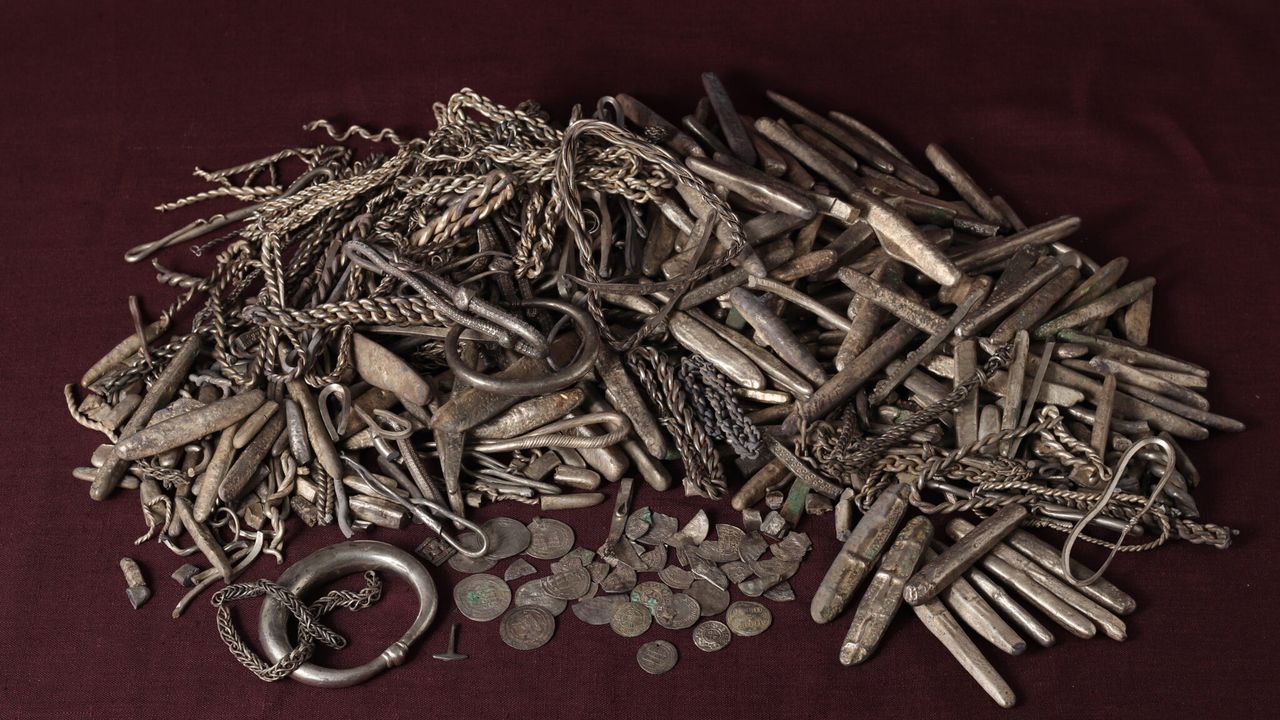
A homeowner in Rebild discovered about 18.5 kilograms of silver while preparing a terrace. The roughly 1,100-year-old hoard contains around 700 objects, including coins, bars, jewelry and a small Thor’s hammer, and is nearly three times larger than Denmark’s previous largest known Viking Age silver hoard.

Read story
Fragments Reveal Previously Unknown Fourth-Century Roman Law Book
05
Artifacts
Score 20

Fragments Reveal Previously Unknown Fourth-Century Roman Law Book

A University of Cincinnati scholar and the Penn Museum have joined 50 animal-skin fragments into a double-sided page from a late-fourth-century Roman legal text. The Latin manuscript discusses taxation and public infrastructure but does not match any previously known imperial legal code.

Read story
Medieval Manuscript Fragments Illuminate Guernsey’s Literary Past
06
Artifacts
Score 20

Medieval Manuscript Fragments Illuminate Guernsey’s Literary Past

Seventeen fragments reused in early modern administrative bindings provide the first substantial evidence of medieval books and reading on Guernsey. Six are written in French, including a rare passage from a dramatic Griselda poem that survives in only one other manuscript.

Read story