
Archaeology.Today
Field Report

Floral Wall Painting Found at Uzbekistan’s Boburtepa Site

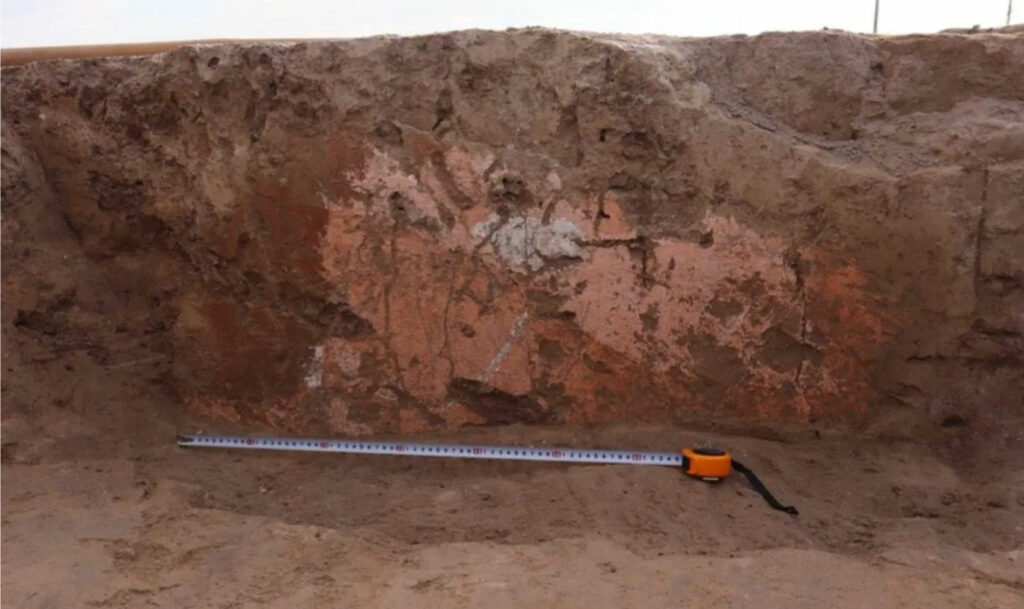
Archaeologists have identified a mural showing tulips and white flowers at Boburtepa in southern Uzbekistan. The decoration was painted on clay inside a building thought to have served as a temple during the fourth and fifth centuries A.D., before being covered with white lime plaster.

September 1, 2026
1 Source
Boburtepa
Floral Wall Painting Found at Uzbekistan’s Boburtepa Site
The Story

A floral mural has been discovered at the Boburtepa archaeological site in southern Uzbekistan, where researchers are examining a building that may have served as a temple during the fourth and fifth centuries A.D.

According to reporting cited by Archaeology Magazine, the find was made by Sanjar Abdurakhimov of the Institute of Archaeology of Samarkand and his colleagues. The wall decoration was painted onto a layer of clay applied to the building’s wall. It includes tulips and white flowers outlined or embellished with thin, wavy red lines.

The mural was later concealed beneath a layer of white lime plaster. The covering preserved the earlier painted surface, although the supplied report does not describe the mural’s condition, dimensions, or the circumstances of its discovery in greater detail.

Researchers have not yet established the building’s function. It is thought to have been used as a temple, but the team plans further investigation to assess that possible interpretation. The floral imagery therefore documents the building’s decoration, while its precise role remains under study.

Reference Desk

Sources & Further Reading

Continue Exploring

Related Archaeology

More stories
Study Examines Unusual 17th-Century Burial in Pień, Poland
01
Discoveries
Score 20

Study Examines Unusual 17th-Century Burial in Pień, Poland

A multidisciplinary study of Grave 75 at a cemetery in Pień examines the remains of a woman who died at about 17–19 years old. A sickle placed across her neck and a padlock fixed to her toe suggest measures intended to prevent the dead from returning, although researchers frame the burial within historical beliefs and social fears.

Read story
Fragments Reveal Previously Unknown Fourth-Century Roman Law Book
02
Artifacts
Score 20

Fragments Reveal Previously Unknown Fourth-Century Roman Law Book

A University of Cincinnati scholar and the Penn Museum have joined 50 animal-skin fragments into a double-sided page from a late-fourth-century Roman legal text. The Latin manuscript discusses taxation and public infrastructure but does not match any previously known imperial legal code.

Read story
Medieval Manuscript Fragments Illuminate Guernsey’s Literary Past
03
Artifacts
Score 20

Medieval Manuscript Fragments Illuminate Guernsey’s Literary Past

Seventeen fragments reused in early modern administrative bindings provide the first substantial evidence of medieval books and reading on Guernsey. Six are written in French, including a rare passage from a dramatic Griselda poem that survives in only one other manuscript.

Read story
Historic Sulfur Emissions Linked to Porosity in Murujuga Rock Art
04
Discoveries
Score 20

Historic Sulfur Emissions Linked to Porosity in Murujuga Rock Art

A three-year monitoring program in Western Australia identifies historic sulfur dioxide emissions and resulting acid rain as the strongest explanation for increased porosity in rock surfaces near industrial areas of Murujuga. Researchers say current pollution has not been shown to accelerate deterioration, while further work will examine microbial and atmospheric factors.

Read story
Ancient DNA Identifies Cacao Consumption at Georgia’s Etowah Site
05
Bioarchaeology
Score 20

Ancient DNA Identifies Cacao Consumption at Georgia’s Etowah Site

DNA recovered from three pottery fragments indicates that people at the Etowah Mounds consumed cacao during the 11th and 12th centuries. The finding provides evidence of cacao use east of the Mississippi River and points to connections with regions where the tropical plant grew.

Read story
Proteins Reveal Complex Paint Recipes in Ancient Egyptian Artworks
06
Ancient Civilizations
Score 20

Proteins Reveal Complex Paint Recipes in Ancient Egyptian Artworks

A study of 28 microscopic samples from 14 Egyptian artworks has identified animal glues from several species along with plant proteins linked to sesame and moringa. The findings suggest painters may have used seed-processing byproducts, offering new information for both ancient craft history and conservation.

Read story