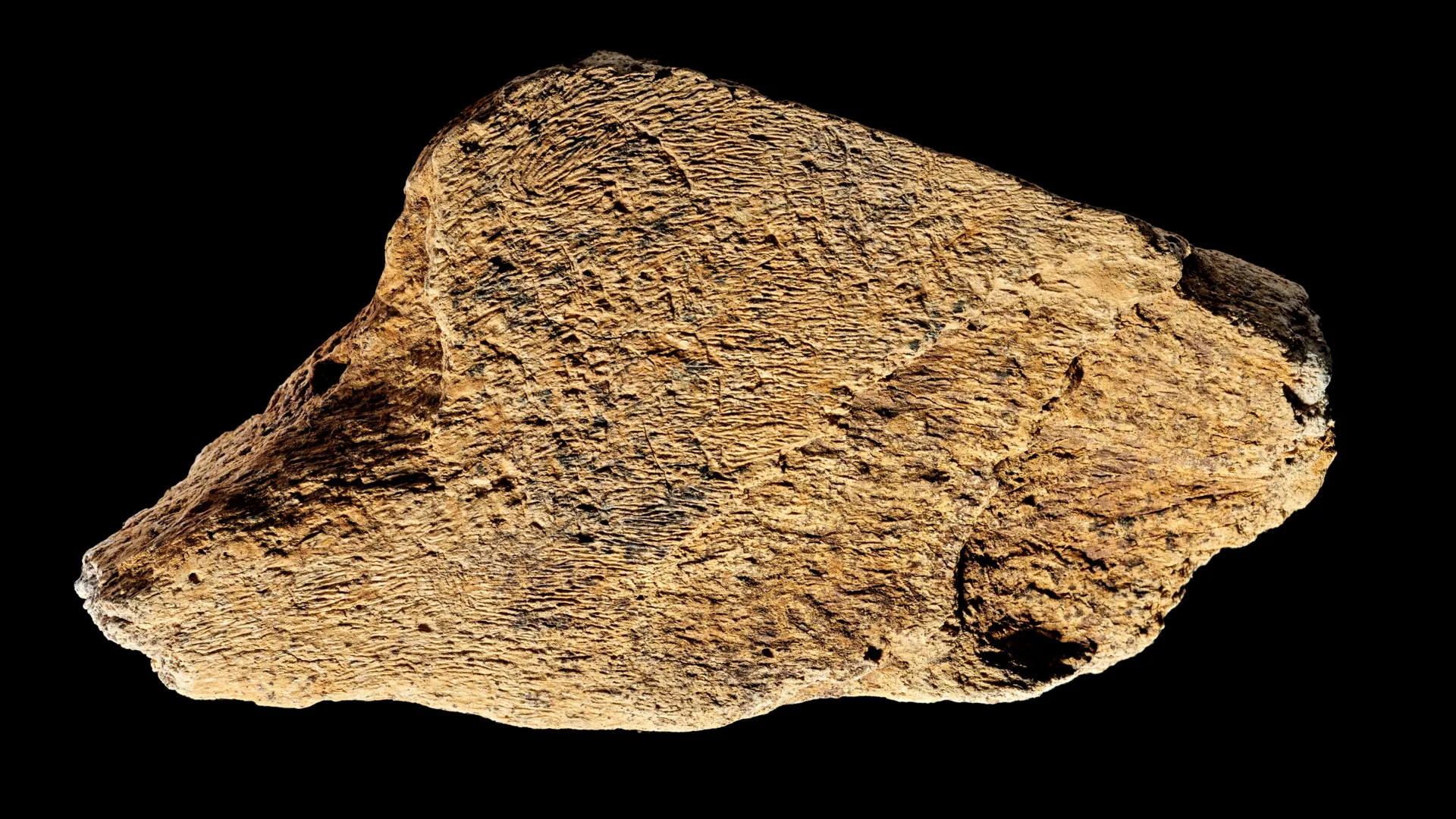
A fragment of elephant or mammoth bone recovered at Boxgrove in West Sussex was used nearly 500,000 years ago to sharpen and repair stone tools, according to research by scientists from University College London and the Natural History Museum in London.
The artifact is roughly triangular and measures about 11 centimeters long, six centimeters wide and three centimeters thick. Although it was found during work at the site in the early 1990s, its function was not recognized at the time. A recent examination identified deliberate shaping and damage consistent with repeated use as a hammering implement.
Researchers used 3D scanning and electron microscopy to study the object. The analysis revealed notches, impact damage and small pieces of flint embedded in its surface. These traces indicate that the bone was used to strike the edges of stone tools, removing small flakes and restoring their cutting surfaces. Archaeologists call an implement used for this purpose a retoucher.
Because the object is made largely of thick cortical bone, the researchers believe it came from an elephant or mammoth. Too little of the original material survives to identify the species or the specific skeletal element. The bone was probably relatively fresh when it was shaped, based on damage and deformation observed on the fragment.
The tool was likely made by early Neanderthals or Homo heidelbergensis, although the available evidence does not establish which group produced it. Researchers also cannot determine whether the animal was hunted or whether its bone was collected from a carcass that had already died.
The finding is notable because elephant-bone tools are exceptionally uncommon in Europe. Before the Boxgrove discovery, no European example was known to be older than approximately 450,000 years, and early examples were concentrated farther south. The researchers say the artifact expands the known geographical and chronological range of elephant-bone technology in Europe.
Its use also suggests that the toolmakers recognized the advantages of a rare material. Dense elephant bone could withstand repeated impacts while providing a softer surface than stone, allowing more controlled work on stone-tool edges. The study, published in Science Advances, presents the object as evidence that early humans in Britain selected and shaped specialized materials for maintaining complex stone implements.