
Archaeology.Today
Field Report

Tiny Projectile Points Found at 80,000-Year-Old Uzbek Site

Researchers have identified small stone points at Uzbekistan’s Obi-Rakhmat rock shelter that may have been used as arrowheads about 80,000 years ago. Their form and impact damage resemble projectile points from the Mandrin site in France, raising questions about how Homo sapiens spread across Eurasia.

September 6, 2026
1 Source
Obi-Rakhmat rock shelter
Tiny Projectile Points Found at 80,000-Year-Old Uzbek Site
The Story

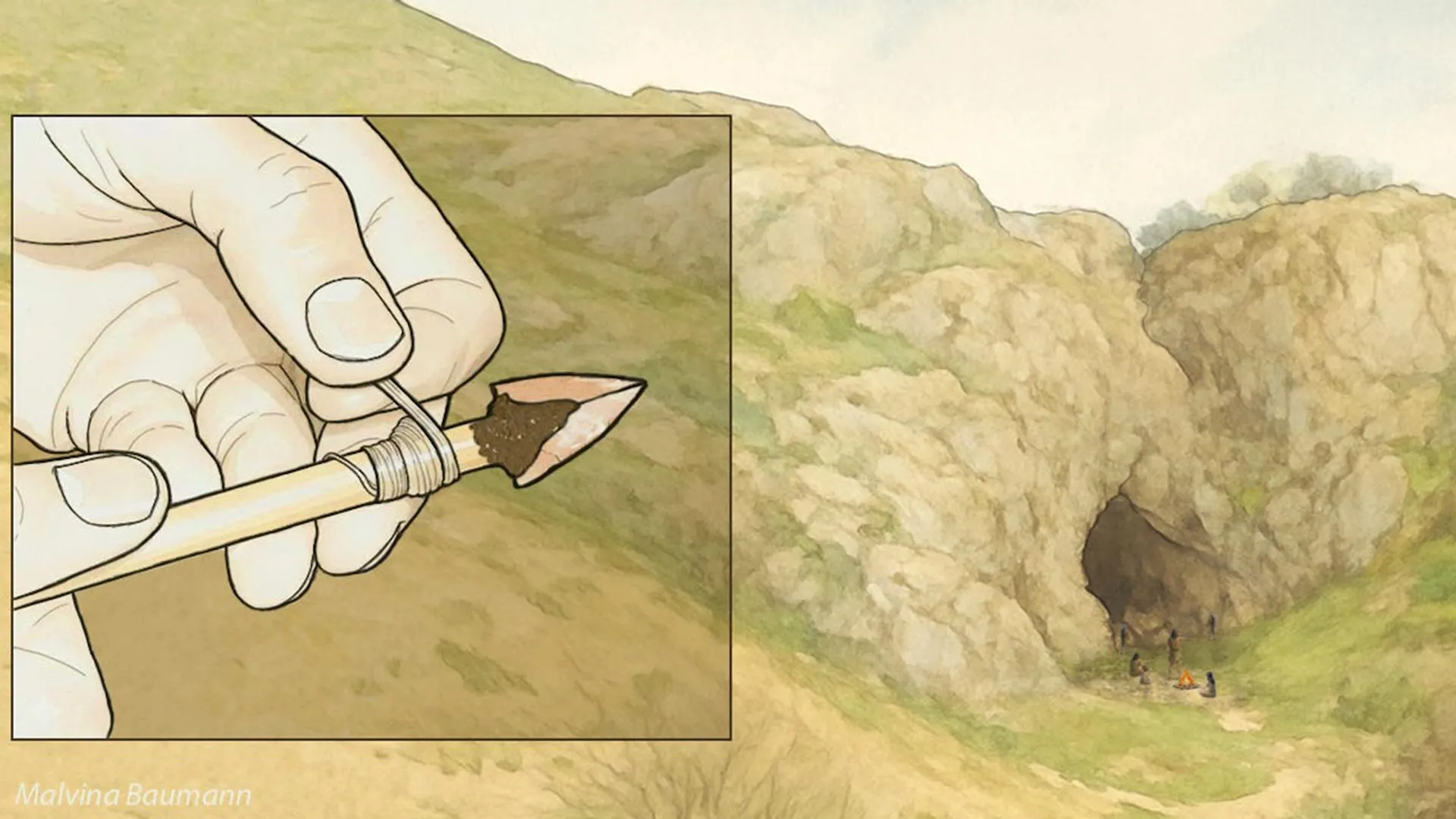
An international research team has identified tiny triangular stone points in the oldest occupation layers of Uzbekistan’s Obi-Rakhmat rock shelter, dating to about 80,000 years ago. The researchers say the objects may have functioned as light projectile points, possibly arrowheads, based on their size and microscopic impact damage.

The findings were reported by The Conversation in connection with a study published in PLOS One. The points are unretouched, less than 2 centimeters wide and weigh only a few grams. According to the researchers, their dimensions would have made them unsuitable for heavy shafts. Their cutting-edge width instead corresponds to arrow shafts documented for low-poundage bows, although the team says it may be more cautious to refer broadly to shooting rather than definitively identify the weapon as a bow.

The interpretation comes from comparisons between macroscopic and microscopic damage on the points and experimental reference data. The Obi-Rakhmat assemblage also contains much heavier, thicker points interpreted as suitable for spears or javelins. This contrast suggests the tiny pieces were not simply smaller versions of more robust hunting points.

The researchers compared the Uzbek specimens with similar projectile points from a layer at the Mandrin site in France dated to approximately 54,000 years ago. That layer also contained a Homo sapiens milk tooth. The two groups of points are separated by more than 6,000 kilometers and about 25,000 years, but the study reports similarities in their shape, manufacture and use damage.

The team argues that the combination of microlithic projectile points and other projectile technologies is currently documented most clearly at Homo sapiens sites. Comparable damaged points are described as rare in the Neanderthal record and generally larger when they occur. The researchers therefore propose that the Obi-Rakhmat points may represent an early example of a technological tradition associated with Homo sapiens, while acknowledging that independent invention in Central Asia and southern Africa is also likely.

Obi-Rakhmat lies at the southwestern end of the Talassky Alatau range in Uzbekistan’s Tien Shan mountains. Excavated deposits at the shelter preserve stone tools dating from roughly 80,000 to 40,000 years ago. A child’s skull from a layer dating to about 70,000 years ago has features considered both Neanderthal and anatomically modern, though the source says this combination could reflect hybridization.

The researchers suggest that Obi-Rakhmat and Mandrin could mark stages in a wider dispersal of Homo sapiens across Eurasia. They also predict that similar, previously overlooked points may be identified at sites between Central Asia and the western Mediterranean. That proposed migration scenario remains an interpretation of the archaeological evidence rather than a settled account of how modern humans reached Europe.


Reference Desk

Sources & Further Reading

Continue Exploring

Related Archaeology

More stories
Neanderthal DNA Pattern Does Not Prove Prehistoric Romance
01
Human Origins
Score 85

Neanderthal DNA Pattern Does Not Prove Prehistoric Romance

An analysis of Neanderthal ancestry on the X chromosome has been interpreted as potentially consistent with partner preference, but the genetic pattern may also reflect biology, migration or social organization. Evidence from Neanderthal sites in Spain and Belgium points to more complex possibilities.

Read story
Ancient DNA Tracks Population Replacement at French Megalithic Tomb
02
Bioarchaeology
Score 65

Ancient DNA Tracks Population Replacement at French Megalithic Tomb

DNA from 132 people buried at a megalithic tomb near Bury, north of Paris, indicates a sharp population break around 3000 BC. Researchers found evidence of disease and severe mortality, but say the collapse likely resulted from several interacting pressures rather than plague alone.

Read story
Excavation in Tonnerre Reveals 1,500 Years of Hilltop Settlement
03
Excavations
Score 65

Excavation in Tonnerre Reveals 1,500 Years of Hilltop Settlement

An Inrap excavation on Montbellant hill in northern France has uncovered medieval buildings, Roman-period remains and evidence of a first-century BC Gallic oppidum. The layered site, investigated ahead of house construction, is helping archaeologists trace the development of Tonnerre’s upper town.

Read story
Bronze-Casting Mould and Weapons Found at Tatarstan Pyanobor Site
04
Excavations
Score 20

Bronze-Casting Mould and Weapons Found at Tatarstan Pyanobor Site

Excavations at the Kipchak Archaeological Complex in Russia’s Tatarstan have yielded a bronze-casting mould, bronze and iron arrowheads, a spearhead, jewellery and decorated pottery. Kazan Federal University archaeologists say the finds may help investigate the debated origins of the Pyanobor culture.

Read story
Villa Complex and 84-Square-Metre Mosaic Found in Eastern Türkiye
05
Excavations
Score 20

Villa Complex and 84-Square-Metre Mosaic Found in Eastern Türkiye

A farmer’s discovery of mosaic remains in Salkaya village led to excavations revealing a settlement with a villa, bathhouse, church, grain-storage area and child’s grave. Archaeologists date the complex to the Late Roman and Early Byzantine periods, but its original owner remains unknown.

Read story
Bear Claws Found in Sixth-Century Elite Burials Near Kaliningrad
06
Artifacts
Score 20

Bear Claws Found in Sixth-Century Elite Burials Near Kaliningrad

Archaeologists identified brown bear claw bones in seven cremation burials on the Kaliningrad Peninsula, including one grave containing 12 claws. The graves also held weapons, precious-metal jewelry, horses and other elaborate goods, suggesting that the burials marked elevated social status, although the precise role of the bear remains is uncertain.

Read story