
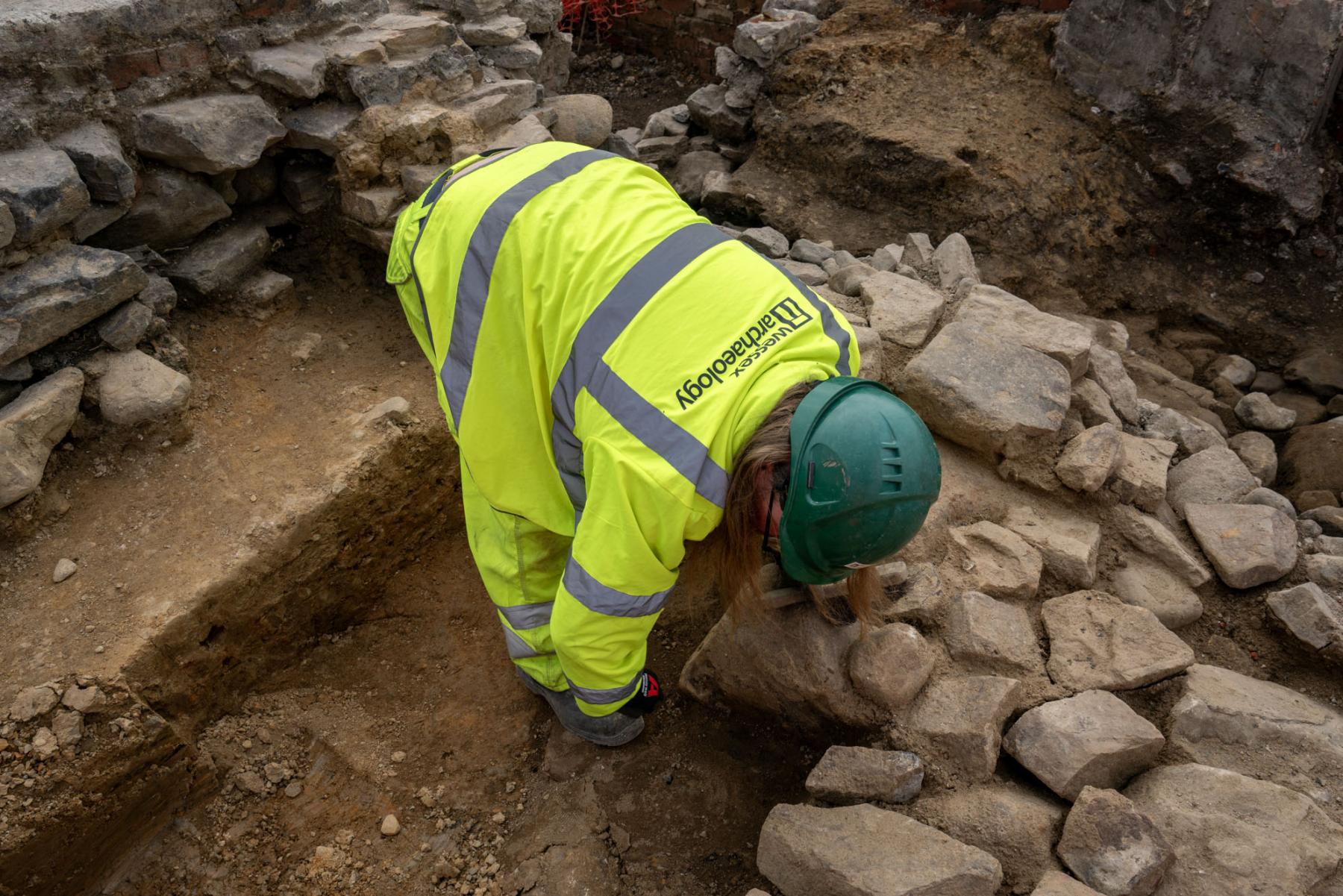
A large-scale excavation at Sheffield Castle has uncovered part of the castle’s drawbridge pier, previously unknown internal walls and evidence that may relate to an earlier phase of the site. The work is taking place at the former Castle Market site as part of Sheffield City Council’s Castlegate regeneration project.
The drawbridge feature is a dressed sandstone platform where the castle’s drawbridge would have rested. Archaeologists from Wessex Archaeology said this is the first time this part of the gatehouse pier has been exposed.
Excavation of the castle’s motte—the manmade defensive mound on which the castle was built—also revealed a series of internal walls. Some are more than 1.5 metres wide. Because no illustrations of the castle survive and documentary references are limited to passing mentions, the walls provide the first tangible evidence reported for the arrangement of the castle’s interior.
The team is using archaeomagnetic dating to establish when the motte was constructed and to investigate the origins of the mound. Work has also exposed the castle’s six-metre-deep moat. Archaeologists say material found there may preserve evidence from before the medieval castle, possibly indicating an earlier castle phase, although that interpretation remains provisional.
Among the moat finds is a mid-16th-century Nuremberg copper-alloy Jetton. The counter would have functioned somewhat like money. Its date places it in the period associated with Mary Queen of Scots’ imprisonment at the castle by her cousin, Queen Elizabeth I, according to Wessex Archaeology.
Ashley Tuck, the archaeologist leading the excavation for Wessex Archaeology, said the newly uncovered walls add to the emerging picture of the castle during its period as a medieval centre of power. He also described the moat evidence as possibly connected with an undocumented earlier phase.
The excavation is overseen by construction engineering specialists Keltbray and is described as the first large-scale professional excavation conducted at the site. Earlier building work exposed parts of the castle in the 1920s and during reconstruction after the Second World War. Wessex Archaeology also carried out trial excavation there in 2018, but the current project is the first to systematically investigate large areas using modern archaeological methods and scientific techniques.


