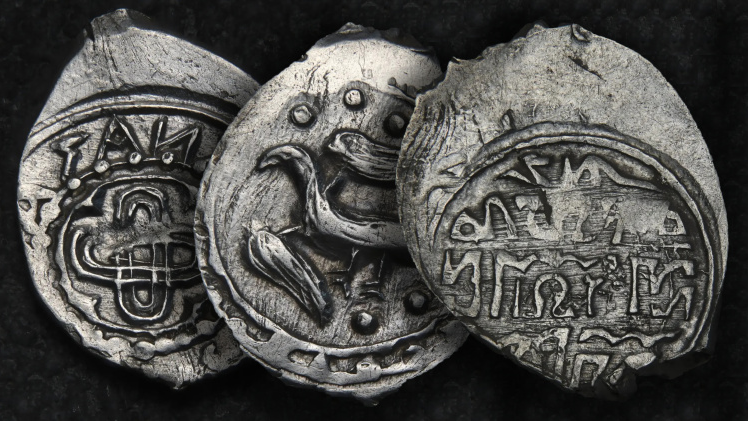
Archaeologists have discovered a medieval hoard of approximately 2,600 silver coins in the historic center of Kolomna, about 114 kilometers southeast of Moscow. The coins were placed in an elegant ceramic jug and buried in a pit.
The find was reported by Live Science, citing a translated statement from the Institute of Archaeology of the Russian Academy of Sciences. Most of the coins are dengas, a denomination first minted in the late 14th century by the Grand Principality of Moscow. A denga was worth half a kopek, and 100 kopeks made a ruble.
The hoard is largely made up of coins minted in Kolomna during the reigns of Vasily I, who ruled from 1389 to 1425, and Vasily II, who ruled from 1425 to 1462. One especially rare example bears the image of a bird in flight and was produced during the final years of Vasily I’s reign.
More than 350 coins represent varieties that experts had not previously documented. Researchers are continuing to study those coins, which may provide additional information about medieval minting in Kolomna.
The size of the hoard and its contents suggest that the person who buried it was probably wealthy and held high social status. The Institute of Archaeology said the owner may have been a senior government official or a highly successful merchant, although the individual’s identity is unknown.
The reason for hiding the coins is also uncertain. The newest coins date to the second half of the 1420s, and researchers believe that timing may be significant. A plague epidemic swept through the Russian principalities between 1424 and 1427, raising the possibility that the hoard’s owner died during the outbreak or was otherwise unable to recover the buried money.
That interpretation remains tentative. The evidence establishes when the latest coins were produced, but it does not directly identify the person who concealed them or confirm that the burial was connected to the epidemic.